Trump vs Iran: Gulf allies fear US ‘help’ may unleash chaos
SOUTH CHINA MORNING POST
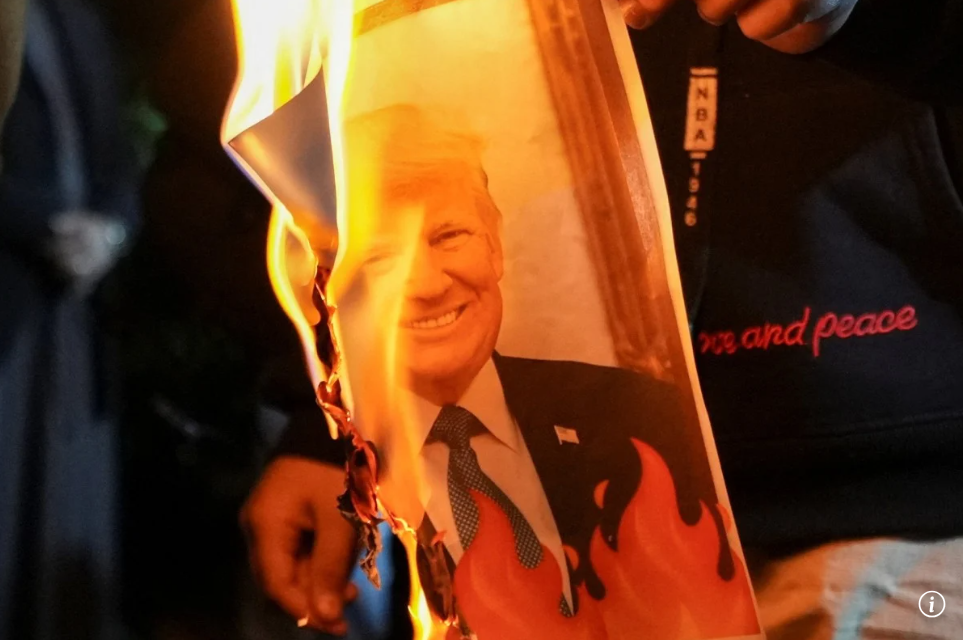
Washington’s Middle East allies are bracing for what they fear could be “catastrophic” consequences if the United States moves militarily against Iran – a possibility US President Donald Trump again dangled this week by promising Iranian protesters that “help is on its way”.
Despite Trump’s vow of support, analysts warn that even a sustained US air campaign would be unlikely to unseat Ayatollah Ali Khamenei’s regime.
The US president’s rhetoric has followed a now-familiar arc, echoing his conduct ahead of last June’s 12-day Israel-Iran conflict: alternating between threats of military action and periodic hints at renewed diplomacy.
While the US did not initially participate in that conflict, it ultimately intervened by striking Iranian nuclear enrichment sites, disabling them and bringing an end to hostilities.
In a social media post on Tuesday, Trump announced that he had cancelled informal talks between US envoy Steve Witkoff and Iranian Foreign Minister Abbas Araghchi, which had tentatively gone ahead even as Iran was convulsed by days of anti-government unrest.
A day earlier, he unveiled a 25 per cent tariff on all countries maintaining trade with Iran – including India and China.
The dual-track approach was about applying “psychological pressure”, said Guy Burton, a Brussels-based researcher and author of China and Middle East Conflicts – with Trump employing a blend of “rhetorical escalation and non-kinetic measures while waiting to see how events inside Iran unfold”.
“The problem,” Burton told This Week in Asia, “is the lack of clarity about what this pressure is ultimately meant to achieve.”
…
Trump’s exhortations have fuelled fears of escalation. But for now, the “help” he has promised is nowhere in sight.
With no US carrier strike group stationed near the Persian Gulf, any American operation would likely be confined to missile strikes, according to Burton, who has taught international relations at universities across the Middle East.
“Even then, it is unclear what such strikes would actually achieve,” he said, adding that destroying elements of Iran’s leadership or command structure would not by itself end the regime.
If anything, such strikes could empower hardliners and allow Tehran “to frame internal protest as collaboration with foreign aggression”, Burton said.
…
Neither was the sudden collapse of the Iranian state “in response to popular pressure” especially desirable, according to Sheline, given the likely legions of refugees it would create and the possible rise of more extremist factions in the power vacuum.
That said, Burton doubted Iran was on the verge of civil war or complete state fragmentation – though he said regional actors were gaming out such scenarios “and they do not like what they see”.
For Turkey, the prospect of a weakened Tehran revives fears of Kurdish militancy spilling across its borders.
From Ankara’s perspective, “Iran losing territorial coherence is not an opportunity, but a serious strategic risk”, Burton said.
Pakistan, meanwhile, is “acutely concerned” about unrest crossing into its restive border province of Balochistan.
“A weakening of Tehran’s grip in eastern Iran would have immediate security implications for Islamabad”, Burton said.
…
TO READ THE ARTICLE [BEHIND THE PAYWALL], CLICK HERE.
