السعودية بين قطبين: كيف توازن الرياض علاقاتها مع واشنطن وبكين؟ [Saudi Arabia between two poles: How does Riyadh balance its relations with Washington and Beijing?]
BBC ARABIC
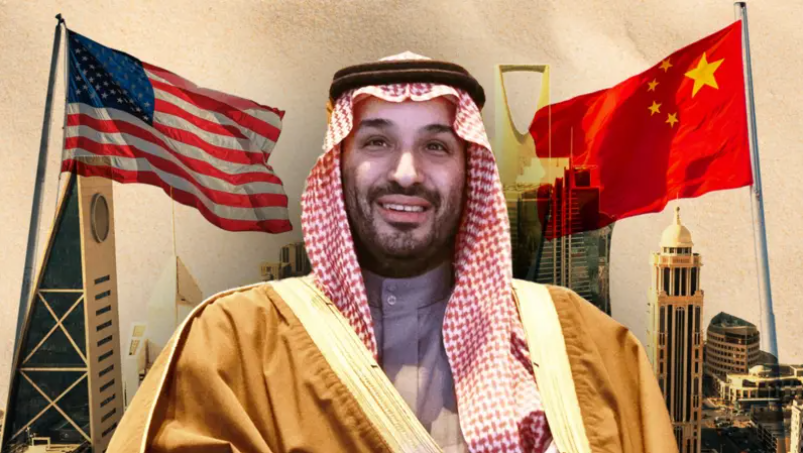
The spring of 1988 witnessed one of the most sensitive moments in the history of Saudi-American relations.
Barely nine months had passed since US Ambassador Hom Horan took up his duties in Riyadh when the Kingdom informed Washington that it did not wish to continue dealing with him, in an unprecedented move.
Despite assurances from US State Department officials to American newspapers at the time that "there was no single reason behind the termination of" the veteran diplomat's duties, the timing was remarkable.
The decision came just weeks after it was revealed that Saudi Arabia had secretly purchased ballistic missiles from China, a move that surprised Washington and was seen as a departure from Riyadh’s long-standing reliance on American weapons.
…
When China agreed to sell ballistic missiles to Saudi Arabia in 1988, the two countries did not have full diplomatic relations. The exchange of ambassadors did not occur until 1990, when Saudi Arabia officially recognized the People's Republic of China and withdrew its recognition of Taiwan.
At that stage, Beijing had moved beyond the "revolutionary ideological" framework that, according to Dr. [Guy] Burton, author of "China and the Conflicts of the Middle East," characterized its relations with Arab states in the 1960s and 1970s.
But despite this, Beijing did not yet view the Gulf as "an important strategic arena," as Burton confirms, since it had not yet entered the stage of increasing dependence on energy imports.
But that changed dramatically after 1993, when China became an importer of oil, and the Arab oil-producing countries, led by Saudi Arabia, quickly emerged as a major supplier of a commodity that had become the lifeblood of China’s economic growth.
This change deepened the economic relationship that linked China to Saudi Arabia and other Gulf states, which was based on the principle of "oil for manufactured goods," without having significant political or security dimensions
…
Aside from arms deals, Ali Shihabi asserts that the United States remains the only partner capable of "providing the security umbrella that Saudi Arabia needs," thanks to its extensive military presence in the Gulf and the deterrence and defense systems it has built over decades.
He says that all of these are things that China is unable to do because it is “not an effective military power in the Middle East,” and does not possess the network of alliances or the operational structure that would allow it to play a security role similar to the American role.
Dr. [Guy] Burton agrees with this view, noting that China's role on the security side remains "complementary".
Burton asserts that what Beijing is offering Riyadh today in terms of armed drones or weapons systems that Washington refuses to sell to the Kingdom remains within the framework of filling gaps, and not reshaping the regional security equation.
According to him, China’s engagement with the Arab Gulf states was primarily “economic and developmental” in nature.
In this context, the relationship between Saudi Arabia and China has expanded from a mere "oil for manufactured goods" formula to include cooperation in the fields of technology, communications, renewable energy, as well as some defense aspects, digital infrastructure, and even exploring cooperation in the field of peaceful nuclear energy, as Burton confirms.
Indeed, the first decade of the millennium witnessed Chinese companies implementing infrastructure and contracting projects within the Kingdom.
But the real turning point came with China’s launch of the “Belt and Road” initiative in 2013, which created an organized framework for expanding China’s economic and investment influence around the world.
Burton points out that Saudi Arabia occupies a central position in Chinese calculations, given the size of its economy and its development projects, most notably "Vision 2030," which, from China's perspective, appeared to be in line with the economic ambitions of the "Belt and Road" initiative.
…
Technological cooperation between Riyadh and Washington extends beyond allowing the export of advanced electronic chips; it also encompasses the crucial minerals used in their production. During Crown Prince Mohammed bin Salman's recent visit to the US capital, an agreement was signed to develop and process a series of rare earth mineral mines located within Saudi Arabia.
Under the agreement, Saudi Arabia’s Ma’aden will partner with US-based MB Materials to establish facilities dedicated to extracting, processing, and refining these minerals within the Kingdom, leading to the manufacture of high-performance magnets, which are a key component in advanced technology industries, from artificial intelligence applications to renewable energy technologies and defense industries.
Washington sees this project as a pivotal step towards breaking China’s near-total dominance over rare earth supply chains, which are the backbone of most modern technological and military industries.
If this project achieves its goals, it could position Saudi Arabia as a competitor in a market where China is the undisputed dominant player. This remains a theoretical possibility, but it has begun to attract Beijing's attention.
Dr. [Guy] Burton says there is a growing awareness within Chinese circles that the relationship with Saudi Arabia, although currently framed as a "partnership," could turn into real competition in some sectors, as the Kingdom expands its ambitions in advanced industries and strategic supply chains, and attempts to build an industrial base that goes beyond the traditional role of oil supplier.
…
TO READ THE ARTICLE IN ARABIC, CLICK HERE.
