Will Trump’s Gaza peace plan work? Netanyahu’s changes spark Arab-Islamic unease
SOUTH CHINA MORNING POST
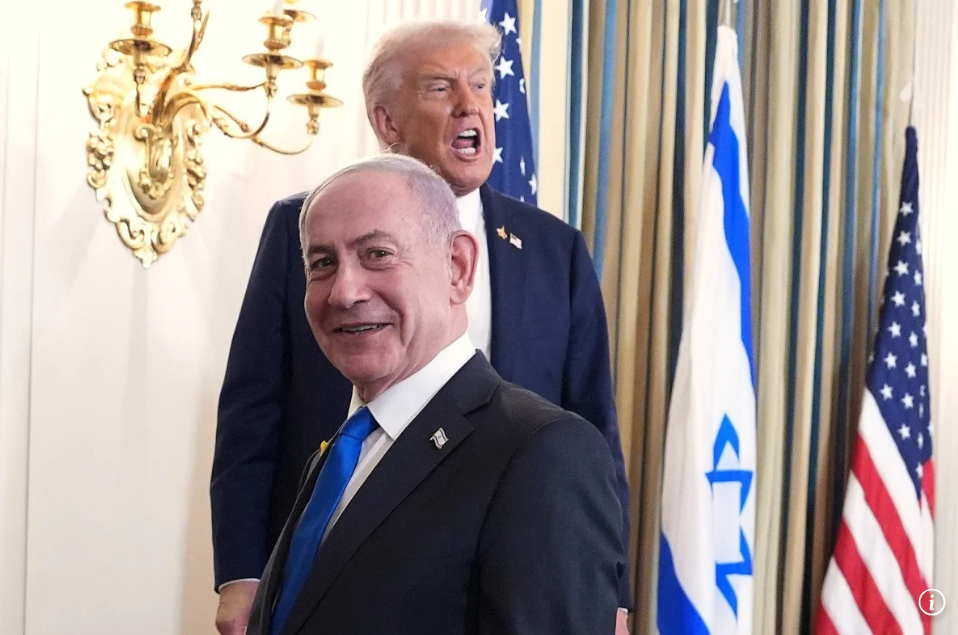
A proposal by US President Donald Trump to end the war in Gaza is already under fire, just days after its release, over last-minute changes pushed by Israeli Prime Minister Benjamin Netanyahu that critics say could undermine Arab-Islamic support and derail the path to peace.
Analysts say the “principles for peace” deal, unveiled on Monday, risks alienating the very Arab and Muslim nations the pact depends on – by allowing Israeli forces to occupy most of Gaza indefinitely unless Palestinian militant groups are fully disarmed to Israel’s satisfaction.
At the centre of the controversy is the insertion of new terms, reportedly at Netanyahu’s insistence, that would leave more than half the enclave under Israeli military control until an International Stabilisation Force (ISF) can secure pacified zones and begin dismantling Hamas and other militant groups.
…
Missing from Trump’s proposal was any prospect of the West Bank-based Palestinian Authority – recently recognised as the Palestinian national government by most Western countries – playing a significant role in Gaza’s future administration for the foreseeable future.
This fundamental demand of Trump’s Arab-Islamic negotiating partners, seen as key to keeping open a pathway to a two-state solution to the Palestinian issue, was cited only in the bloc’s cautiously worded joint statement to welcome Trump’s proposal.
There was no mention of prospectively normalising relations with the Jewish-majority state in the joint statement.
Instead, it focused on humanitarian relief for Gazans and preventing the territory’s annexation by Israel, noted Guy Burton, co-author of The Abraham Accords: National Security, Regional Order, and Popular Representation.
“But huge questions remain,” he said, including who would contribute to the ISF, and how they would operate alongside the Israel Defence Forces, which Netanyahu insisted would remain in Gaza.
“For Arab or Islamic states to put their soldiers in potential confrontation with Hamas – or to be seen as propping up Israeli control – is a very unattractive proposition,” Burton said.
At the same time, “these governments are torn”. Elites wanted the benefits of normalisation with Israel and closer ties with Washington, he said, “but they are operating in an environment of volatile and angry public opinion”.
“If the deal collapses, Arab states risk looking complicit in an externally imposed farce,” said Burton, who expected most of them to “hedge” by offering cautious rhetorical support while avoiding heavy commitments, either to the ISF or to the Board of Peace.
…
TO READ THE ARTICLE, CLICK HERE.
