BRICS summit: Is the bloc truly challenging a Western-dominated world?
AL JAZEERA
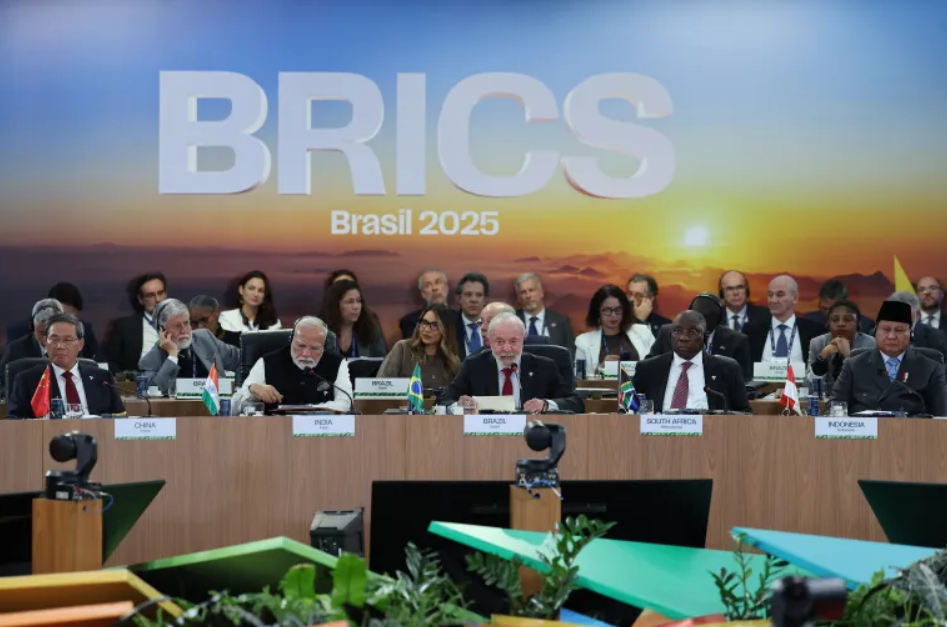
Some experts say BRICS need not replace the West to succeed – only make Western dominance harder to exercise.
A BRICS member has been under attack for months – and has subsequently wielded attacks of its own against fellow members.
This coming weekend, those countries will all be in the same room, making a third attempt to find consensus on a war that has dominated global attention – and battered economies – this year.
India hosts the BRICS Leaders’ Summit from Saturday, seeking to raise the bloc’s profile even as the United States-led war on Iran exposes divisions among its members, with Tehran and Abu Dhabi on opposing sides. Russian President Vladimir Putin landed in New Delhi on Friday morning.
The September 12-13 summit in New Delhi comes more than six months after the US and Israel launched attacks on Iran, which has been a BRICS member since 2024. The United Arab Emirates also joined that year.
The grouping of emerging countries – Brazil, Russia, India, China, South Africa, and in more recent years Iran, the UAE, Saudi Arabia, Egypt, Ethiopia and Indonesia – was created to challenge the Western-led order.
….
Concurrently, the very idea of the so-called West has changed dramatically since the early 2000s, when BRICS was conceived and formalised, operating in an entirely different global environment, points out Guy Burton, a geopolitical and policy analyst.
The notion of the West is “breaking down now, with the transatlantic relationship between the US and Europe fracturing – so it’s unclear what BRICS would even be challenging, or whom, America or Europe,” Burton told Al Jazeera.
…
Perhaps the most significant limitation on BRICS’s ability to challenge Western economic power is its continued structural reliance on the US dollar, the analysts agreed.
…
While China has pushed use of the renminbi and Saudi Arabia has floated trade in other currencies, the dollar faces no serious challenge – and it is unlikely to for the next decade, said Burton.
…
At a meeting of the grouping’s foreign ministers in May — also in India — the BRICS failed to form a consensus on the US-Israel war on Iran.
…
Burton, however, said the bloc’s expansion has made BRICS’s internal divisions more confusing, not less.
“It widens Global South representation but dilutes whatever coherent positioning the group had,” he argued.
On Iran, he added, BRICS membership gave Tehran a platform, but that doesn’t mean the bloc’s members are aligning themselves with the country.
“There’s no ‘one for all, all for one’ logic in BRICS – members deliberately preserve their freedom to act independently, which is the opposite of a coordinated bloc,” said Burton.
…
TO READ THE WHOLE ARTICLE, CLICK HERE.
