Trump-Xi Beijing Summit Tests Leverage on Trade, Taiwan, Iran
THE MEDIA LINE
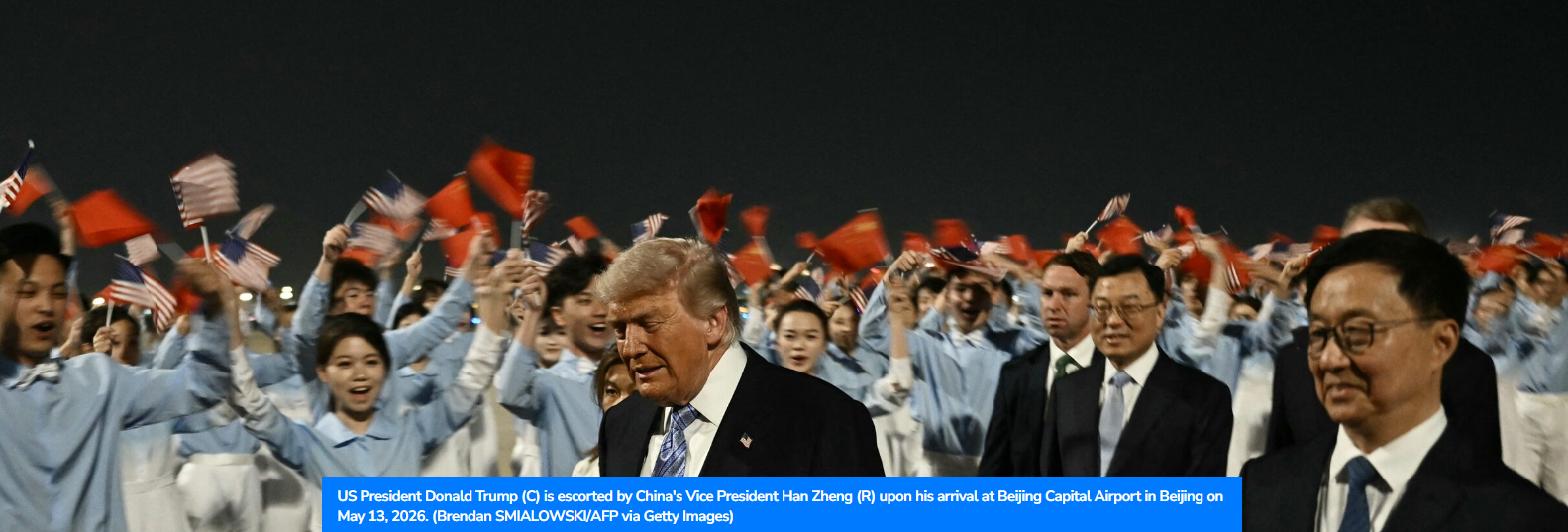
Temporary deals on tariffs, rare earths, and diplomatic language may give both leaders short-term wins while leaving deeper conflicts untouched.
US President Donald Trump arrived in Beijing on Wednesday for a state visit and scheduled talks with Chinese President Xi Jinping, with trade, rare earths, Taiwan, artificial intelligence, and the Iran war expected to dominate the agenda. The visit may produce visible deliverables, but the larger test is whether either side can gain leverage while leaving the deepest disputes unresolved.
...
Guy Burton, author of China and Middle East Conflicts and visiting fellow at Lancaster University, also said the Beijing talks should not be mistaken for a decisive turning point in the relationship. High-level summits, he told The Media Line, are often treated as historic moments, but the main forces shaping US-China relations are structural, long-term, and already in motion.
Burton identified Taiwan, trade, rare earths, and Iran as central issues, but argued that the wider challenge for Washington lies in the ambiguity of its own strategic messaging. He said “the current US position often appears internally inconsistent,” making it difficult for both allies and adversaries to determine Washington’s priorities.
...
For Burton, the question is not only whether Beijing can influence Tehran, but whether Washington’s own Iran policy is clear enough to persuade China that cooperation would serve a defined objective. He said US policy has moved among several stated aims, including preventing nuclear escalation, weakening Iran’s regional influence, and broader regime-change signals, creating uncertainty for allies and adversaries.
Burton said President Trump’s statements matter because he remains the American president, but Washington’s frequent shifts make US signaling harder to interpret.
...
For Burton, Taiwan is precisely where US ambiguity becomes most consequential. He said one of Beijing’s likely red lines will be preventing any formal strengthening of US commitments toward Taiwanese sovereignty or security guarantees beyond Washington’s traditional framework of strategic ambiguity.
“Chinese leaders will be especially attentive to whether Trump might casually concede rhetorical ground, improvise unexpectedly or alter longstanding diplomatic formulations in ways that create instability,” Burton said.
…
TO READ THE FULL ARTICLE, CLICK HERE.
