Lula’s victory echoes across BRICS after fears of a Bolsonaro win
AL JAZEERA
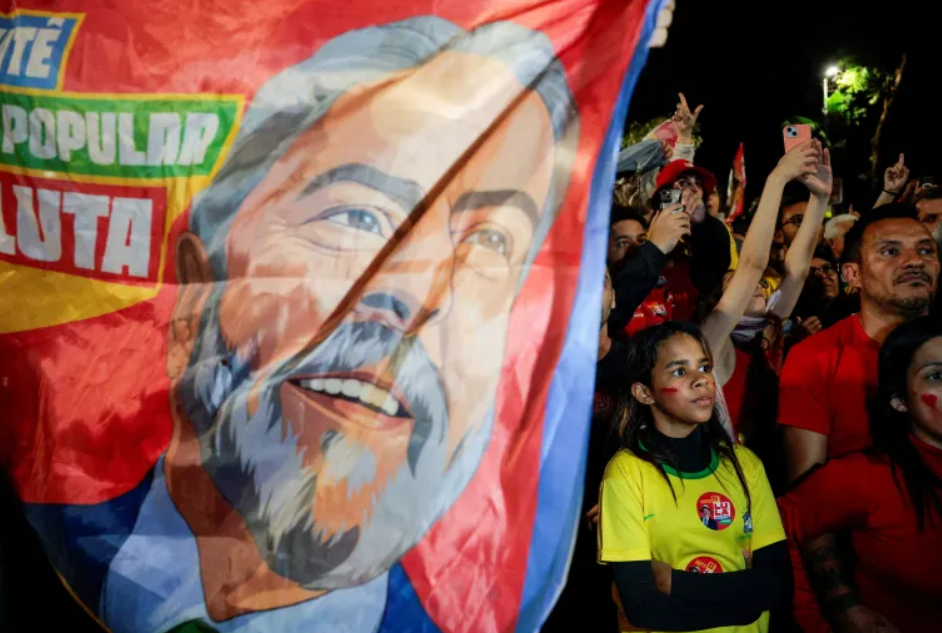
Lula’s fourth term may have spared BRICS an internal fracture at a time when Trump is trying to pressure countries back into Washington’s orbit.
When Brazil’s President Luiz Inacio Lula da Silva scored his surprise election victory on Sunday, winning an unprecedented fourth term in office, his supporters were euphoric.
The joy they felt over Lula’s victory has echoed across large parts of the Global South – and could restore some hope to the grouping that has sought to give emerging countries a greater stake on the world stage, the BRICS alliance.
At a time when United States President Donald Trump is seeking to reassert US power and has cast BRICS as a threat to US interests, Lula’s victory in Brazil offers the alliance a measure of political reassurance, experts say.
…
Guy Burton, a geopolitical and policy analyst, agreed that the bloc’s differences will remain unchanged with Brazil’s election result.
“BRICS matters because it represents a large share of the world’s population, economy and trade. But it has never really acted as a political unit. Its members are too different,” he said.
“The bloc now includes Iran and the UAE, which sit on opposite sides of the current war. That tells you how limited its cohesion is,” Burton added.
…
Lula has long advocated for a more multipolar international system, in which emerging economies have a stronger voice when it comes to shaping international rules and institutions, added Zaidan.
Burton said even countries and regions beyond the Global South are looking to lessen their reliance on Washington, including Europe, which is building its own security against Russia and in support of Ukraine.
“So states, whether in the Western camp or not, have accepted that they must pursue their own interests. That means working with whoever they can. We are moving into a genuinely multipolar world,” he said.
…
Many in the alliance maintain strong economic and security relationships with the US, said Zaidan.
…
Burton agreed, pointing to Brazil’s changing ties with Trump over the years.
“Russia and China are the obvious US rivals. But India under Modi long had a close relationship with Washington, and with Trump in particular, even if that has weakened recently,” he said.
“Brazil, too, was close to Trump under Jair Bolsonaro, Flavio Bolsonaro’s father, when he was in office.”
…
Among the BRICS’ many ambitions is to promote trade in local currencies rather than the US dollar – and Lula’s victory could provide the political foundation to build on these efforts, said Zaidan, given that Brazil is one of the largest trading economies in the bloc.
…
For now the dollar reigns supreme in foreign exchange transactions, and there may be no tipping point for another decade or so, Burton said.
Ultimately, though, Lula’s victory could help BRICS move from political discussions towards more practical financial cooperation, while reducing dollar dependence will be “gradual, uneven and driven as much by economic feasibility as by geopolitical ambition”, said Zaidan.
How Washington reacts to this is another variable; Trump’s government sits at the contradiction of wanting to remain the world’s superpower, while also retreating to a more protectionist America-first role, said Burton.
“Developments such as Lula’s re-election will only sharpen the pressures already building in the Global North,” said the expert.
TO READ THE WHOLE ARTICLE, CLICK HERE.
